
Allowance Chart Ideas for Kids (Save, Spend, Give)
Keep the first chart simple
An allowance chart for kids can be a record rather than a complicated budget. Start with spaces for the date, money received, money used and the amount remaining. Leave enough room for handwriting. Younger children can draw coins or use tally marks with adult help; older elementary students may be ready to write dollar amounts. A notebook page works if you do not want to print anything yet.
Talk about what allowance means in your household before introducing a chart. Some families use a regular allowance, some connect certain payments to jobs, and others begin by recording gifts. Explain your arrangement clearly and revisit it if needed. The worksheet should reflect your family’s choices, not decide them for you. Keep the first record small enough that your child can understand each column.
Introduce save, spend and give
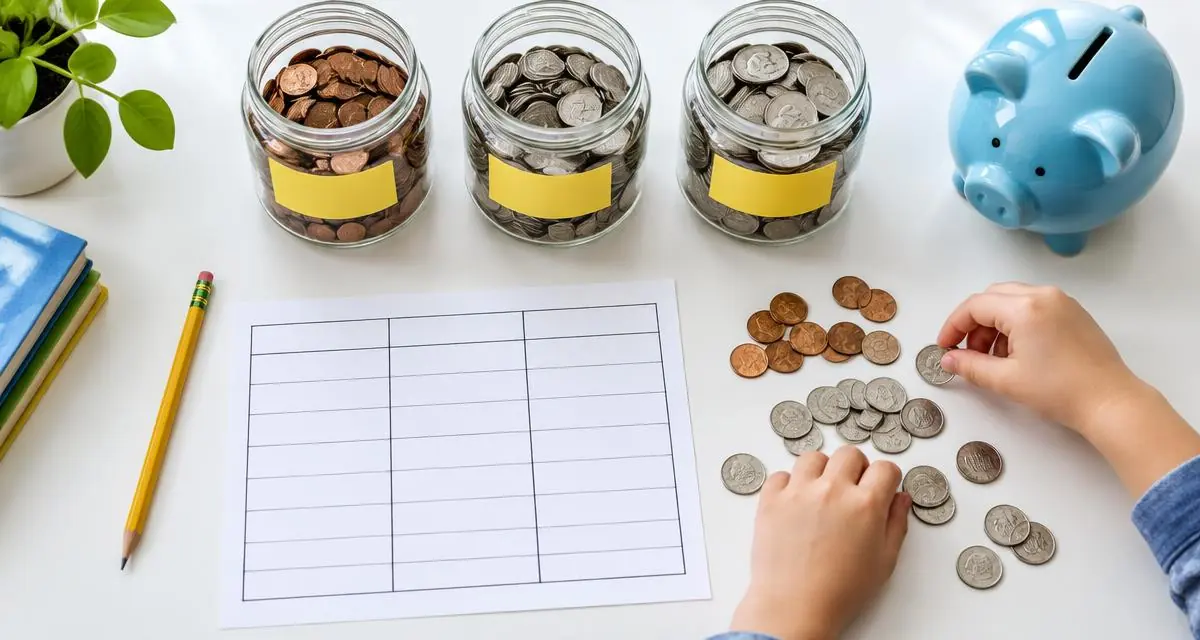
Three labeled jars or envelopes can make the categories visible. Spend holds money for a near-term choice. Save holds money for a later goal. Give holds money the child chooses to share. You can use a save, spend, give worksheet alongside the containers, or skip the containers and record the amounts on paper. Ask your child to explain the categories in their own words.
There is no one correct percentage split for every family. Discuss what each category is for and decide together how to divide a particular amount. A small saving goal, such as a book, gives the conversation a concrete example. Let the child help choose an appropriate giving opportunity. Avoid treating one decision as proof of being good or bad; the purpose is to talk through choices and keep an understandable record.
Use the tracker for ordinary arithmetic
A kids money tracker printable creates opportunities to add and subtract with a reason. Record the starting balance, add any money received and subtract a purchase. Count coins together if your child needs a physical example. Check the written total against the money in the container. If the numbers differ, look through the entries and see whether something was missed.
Before a purchase, ask what the item costs and how much is available. Invite your child to compare the choice with another use for the money. Waiting until the next day can be an option, not a punishment. Keep the discussion practical and appropriate to your child’s age. This is a family learning activity rather than financial advice, and no worksheet can promise a particular saving habit or result.
Choose an easy weekly check-in
Update the chart on allowance day or at another moment that fits your household. Store it where you can find it, with a pencil nearby. If you print at home, choose US Letter paper and preview the page to avoid cutting off columns. Make a new copy when the chart fills up rather than shrinking it until the numbers are difficult to read. Simple and legible is more useful than decorative.
After a few weeks, ask which parts of the system are clear and which feel cumbersome. Remove unnecessary columns, change the check-in day or simplify the categories if that helps. DigitalByVB’s five-pack Etsy bundle includes a money tracker along with math, science, journal and party materials. Check the listing below for the current price and product details. For more examples of family money conversations, explore the related allowance article; a little flexibility keeps the record connected to real decisions.